
General Mobile Radio Service (GMRS). A mobile two-way voice communication service, with limited data applications, for facilitating activities of individual licensees and their family members, including, but not limited to, voluntary provision of assistance to the public during emergencies and natural disasters. Cost of FCC License $35 (10 years) $3.50 per year. An HT radio $25.
Good to have backup to backup. GMRS will allow more contacts in an emergency. HT 5 Watts Range – 48-inch folding tactical 20 Miles (Max).
GMRS may be a good way to introduce people to radio and then have them move to a Technician License.
Who is covered: The license covers the licensee and their immediate family, which includes their spouse, children, grandchildren, parents, grandparents, siblings, aunts, uncles, nieces, and nephews.
CALL SIGN Licencee is responsible for any FAMILY members who use your call sign :
FCC RULES – NO test – Follow the rules
FCC LAW LINK
You must say the call sign at the end of transmission and/or every 15 minutes.
https://www.ecfr.gov/current/title-47/chapter-I/subchapter-D/part-95/subpart-E
95.1731 Permissible GMRS uses
The operator of a GMRS station may use that station for two-way plain language voice communications with other GMRS stations and with FRS units concerning personal or business activities.
(a) Emergency communications. Any GMRS channel may be used for emergency communications or for traveler assistance. Operators of GMRS stations must, at all times and on all channels, give priority to emergency communications.
(b) One-way communications. The operator of a GMRS station may use that station to transmit one-way communications:
(1) To call for help or transmit other emergency communications;
(2) To provide warnings of hazardous road conditions to travelers; or,
(3) To make brief test transmissions.
(c) Travelers assistance. The operator of a GMRS station may transmit communications necessary to assist a traveler to reach a destination or to receive necessary services.
(d) Digital data. GMRS hand-held portable units may transmit digital data containing location information, or requesting location information from one or more other GMRS or FRS units, or containing a brief text message to another specific GMRS or FRS unit.
95.1733 Prohibited GMRS uses
§ 95.1733 Prohibited GMRS uses.
(a) In addition to the prohibited uses outlined in § 95.333 of this chapter, GMRS stations must not communicate:
(1) Messages in connection with any activity which is against Federal, State, or local law;
(2) False or deceptive messages;
(3) Coded messages or messages with hidden meanings (“10 codes” are permissible);
(4) Music, whistling, sound effects or material to amuse or entertain;
(5) Advertisements or offers for the sale of goods or services;
(6) Advertisements for a political candidate or political campaign (messages about the campaign business may be communicated);
(7) International distress signals, such as the word “Mayday” (except when on a ship, aircraft or other vehicle in immediate danger to ask for help);
(8) Messages which are both conveyed by a wireline control link and transmitted by a GMRS station;
(9) Messages (except emergency messages) to any station in the Amateur Radio Service, to any unauthorized station, or to any foreign station;
(10) Continuous or uninterrupted transmissions, except for communications involving the immediate safety of life or property; and
(11) Messages for public address systems.
(12) The provision of § 95.333 apply, however, if the licensee is a corporation and the license so indicates, it may use its GMRS system to furnish non-profit radio communication service to its parent corporation, to another subsidiary of the same parent, or to its own subsidiary.
(b) GMRS stations must not be used for one-way communications other than those listed in § 95.1731(b). Initial transmissions to establish two-way communications and data transmissions listed in § 95
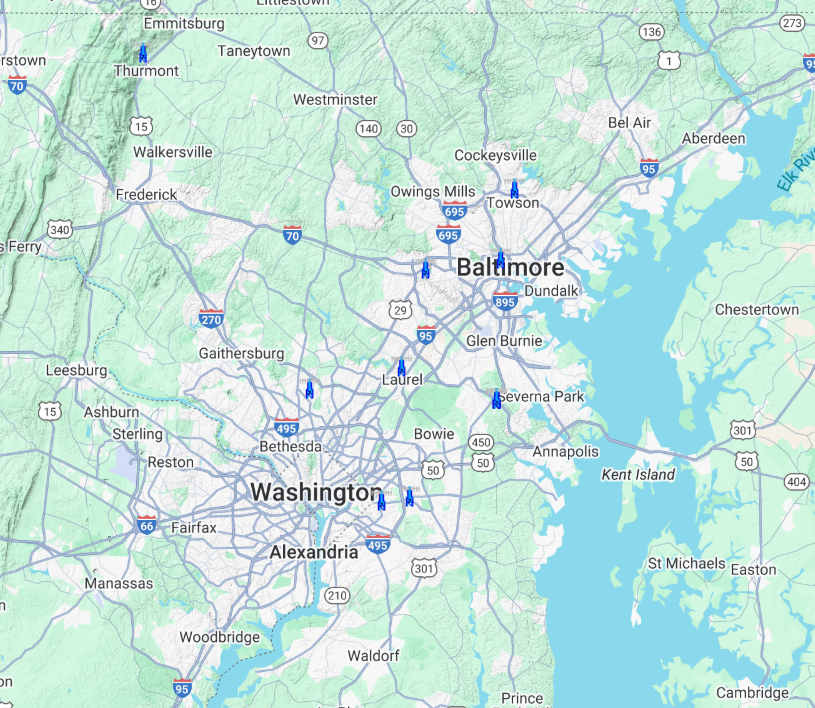
https://www.repeaterbook.com/gmrs/index.php?country_code=US&state_id=24
Repeaters relay the signal. They cover up to 30+ miles, depending on the line of sight.
